Held Up, Not Built: Inside Britain's Scaffolding Squeeze

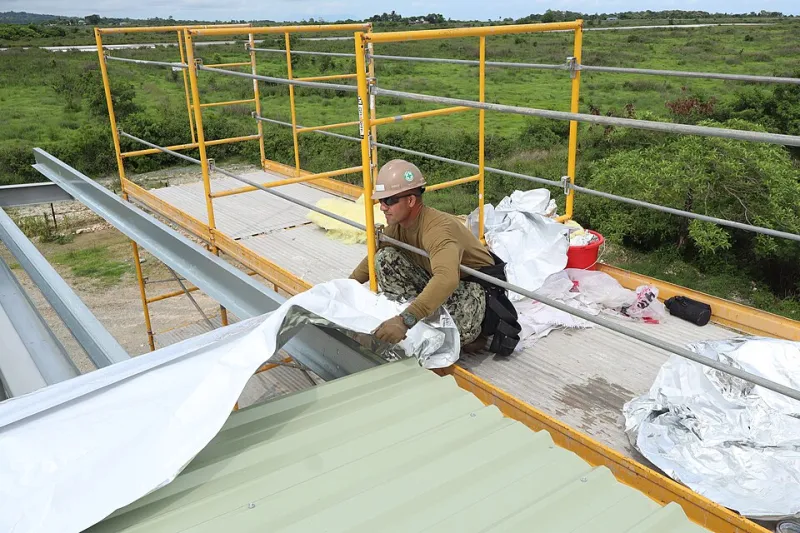
Photo: Philip Halling , CC BY-SA 2.0, via Wikimedia Commons
For most of his thirty years on the tools, a scaffold was something Mark Ellison ordered and, within a fortnight, stood on. These days the Leicester-based builder counts himself lucky if a hire firm answers the phone inside a week.
"We had a re-roof booked for March," he says. "The scaffold firm rang in February to say they'd moved us to September. Not delayed a fortnight — moved. Six months. You can't hold a client's roof open that long."
Ellison's experience is no longer the exception. Across Britain, scaffolding — the most unglamorous of trades — has become one of the most contested resources on site, and in 2025 it is quietly deciding which projects proceed and which sit in a queue.
The Price of Standing Still
The arithmetic behind the crunch is straightforward. Scaffolding depends on two commodities: steel tube and timber battens. Both have seen sustained price pressure since 2022, driven by energy costs, European mill output and freight volatility. Add to that the replacement cycle — much of the country's scaffold stock was bought in the 1990s and 2000s and is now due for renewal — and the supply of hireable kit has thinned just as demand has hardened.
Rental rates reflect the squeeze. Several small builders spoken to for this piece reported paying two to three times the rates they were quoted before 2021 for identical tower and independent hires, with minimum hire periods lengthening and availability windows shrinking.
"It's not just the money," says one scaffold contractor in the South West, who asked not to be named while contracts were being renegotiated. "It's the sequencing. We're having to triage. A housing developer with four hundred plots gets priority over a single extension, because that's where the volume is. It's commercial reality, but it stings."
Who Waits, Who Pays
The burden falls unevenly. Large housebuilders, with framework agreements and national accounts, are largely insulated. Regional developers have absorbed some cost. But the small builder — the sole trader re-roofing a terrace in Leeds, the two-man firm rendering a semi in Cardiff — has neither leverage nor alternatives.
The result is a two-tier market. Those who can pay, or who booked early, build. Those who cannot, wait — or improvise, and improvisation on a roof is where safety margins erode.
Trade bodies have warned against exactly this. The Work at Height Regulations do not bend for a supply shortage, and there are early signs that some builders are keeping scaffold up longer than planned because they fear they won't get it back. That inflates the apparent demand further, a feedback loop that pushes the next customer further down the queue.
Can Off-Site Break the Bottleneck?
Some in the industry see the shortage as an accelerant for change. Modular and panelised construction — roof cassettes, SIPs, volumetric units — reduces the duration a scaffold must stand, even if it doesn't remove the need entirely.
"If your roof goes on in two days instead of three weeks, you've freed that scaffold for the next job," argues a technical manager at a North West off-site manufacturer. "Scaffold scarcity is really a time-on-scaffold problem. Shorten the time, and the maths changes."
There is truth in that, but it is a partial answer. Off-site methods suit new build and repetitive layouts far better than the refurbishment and extension work that dominates the small-builder economy. A Victorian terrace in Birmingham cannot be panelised away.
For most contractors, the near-term coping strategies are more prosaic: book scaffold at quotation stage rather than contract award; build hire inflation into tenders; and, where possible, establish direct relationships with scaffold firms rather than leaving it to the last minute.
A Trade Worth Backing
The deeper issue is capacity. Scaffold inspection and erection remains a skilled, physically demanding trade with an ageing workforce, and training pipelines have not kept pace with demand. If government and industry are serious about housing targets, the scaffolding sector — small, fragmented and rarely headline material — deserves a place in the skills conversation alongside bricklayers and electricians.
Until then, the queue remains. Mark Ellison has pencilled his re-roof in for September, and he has learned not to assume even that.
"Thirty years I've done this," he says. "Never thought I'd be beaten to a job by a scaffold pole."