Cutting Out the Counter: The Builders Quietly Becoming Their Own Merchants
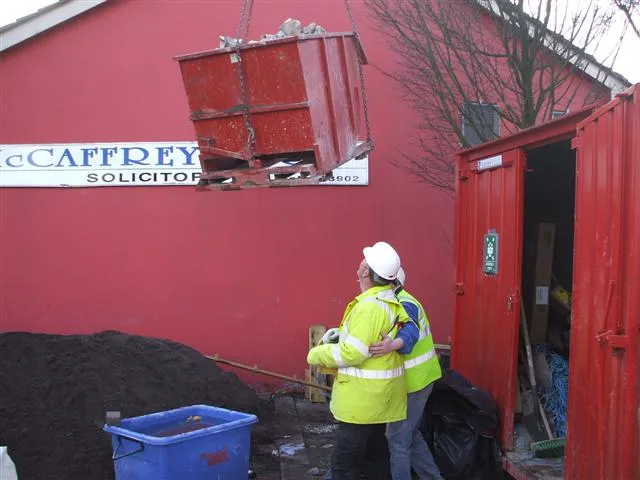
Photo: Kenneth Allen, CC BY-SA 2.0, via Wikimedia Commons
For most of the past century, the rhythm of a British building site has started at the same place: the merchant counter. The early queue, the flask of tea in the van, the carbon-copy invoice folded into the sun visor. It is a ritual so entrenched that the builder's merchant has long seemed as permanent a fixture of the trade as the brickie's trowel.
It may not be. Across the country, a growing number of builders, site managers and small contracting firms are quietly reorganising how materials reach their sites — ordering direct from manufacturers, grouping purchases across several jobs, and in some cases reselling surplus stock to neighbouring sites at a modest mark-up. The merchant, once the unavoidable middleman, is increasingly optional.
The Arithmetic of Going Direct
The logic is straightforward enough. A pallet of engineering bricks bought through a merchant carries a margin that reflects storage, delivery, credit terms and counter service. Buy the same pallet direct from the works — or through a manufacturer's trade portal — and that margin, or a portion of it, stays with the buyer.
For a single bathroom refit, the saving is trivial. For a firm running three or four jobs simultaneously, it compounds. One site manager in the West Midlands, who asked not to be named while his merchant relationships remain live, estimates his company now sources roughly 60 per cent of its materials outside the traditional counter. On a £400,000 commercial fit-out, he says, the difference runs to five figures.
The practice has been made easier by manufacturers themselves. Facing flattening volumes through the merchant channel, several major producers of insulation, plasterboard and rainwater goods have opened direct trade accounts with lower thresholds than they would have demanded a decade ago. What was once a relationship reserved for national housebuilders is now available to a firm with two vans and a decent credit history.
The Informal Wholesale Network
The more interesting development is what happens next. When a builder bulk-orders to secure a price, they frequently order more than one job requires. That surplus has to go somewhere — and increasingly it goes to the site next door.
There is nothing formally organised about this. It is a text message, a word at the school gates, a photo of ten spare rolls of membrane in a WhatsApp group. But the effect resembles a shadow distribution network: trade materials changing hands between firms at prices that undercut the counter, with no paperwork beyond a bank transfer and a nod.
Nobody involved considers themselves a merchant. That is rather the point. Informal resale at this scale sits in a grey area — generally lawful, rarely declared as trading income, and entirely invisible to the industry's official statistics. Its scale is therefore impossible to measure precisely, but its existence is acknowledged by nearly everyone in the trade who will speak candidly.
What the Merchant Still Offers
Defenders of the traditional model point out what direct buying cannot replicate. The merchant's yard holds stock today, not in three weeks' time. It extends credit to firms whose cash flow depends on it. It accepts the return of the pallet that arrived damaged, the wrong-gauge fixings, the four bags of screed left over through no fault of the buyer.
There is also expertise. A good counter hand knows which adhesive actually works with that board, and which supplier's deliveries are currently unreliable. That knowledge does not appear on an invoice, but it prevents expensive mistakes — and it is precisely what a builder ordering from a manufacturer's web portal goes without.
The merchants, for their part, are not standing still. Several regional chains have responded with price-matching schemes, simplified direct-to-site drops, and loyalty pricing aimed at the small and medium firms most tempted to defect. The fight, in effect, is for the middle of the market: the one-van sole trader will always need the counter, and the national contractor already buys direct.
A Structural Shift, Not a Rebellion
It would be easy to frame this as builders turning against their merchants. The reality is more mundane and more significant: it is a rational response to squeezed margins on fixed-price contracts, at a moment when digital ordering has removed much of the friction that once made the counter indispensable.
Whether the informal networks endure depends on conditions. A period of volatile prices rewards bulk buying; a market of shortages rewards whoever holds stock. The merchant's resilience has always been countercyclical in exactly this way.
But the direction of travel is hard to ignore. Each builder who opens a direct account weakens, slightly, the volume that sustains the local yard — and each weakened yard makes direct buying more attractive still. The trade's supply chain is not being revolutionised. It is being quietly renegotiated, one pallet at a time.