Patching Forever: The Carpenters Stuck Mending a Social Housing Backlog That Never Shrinks
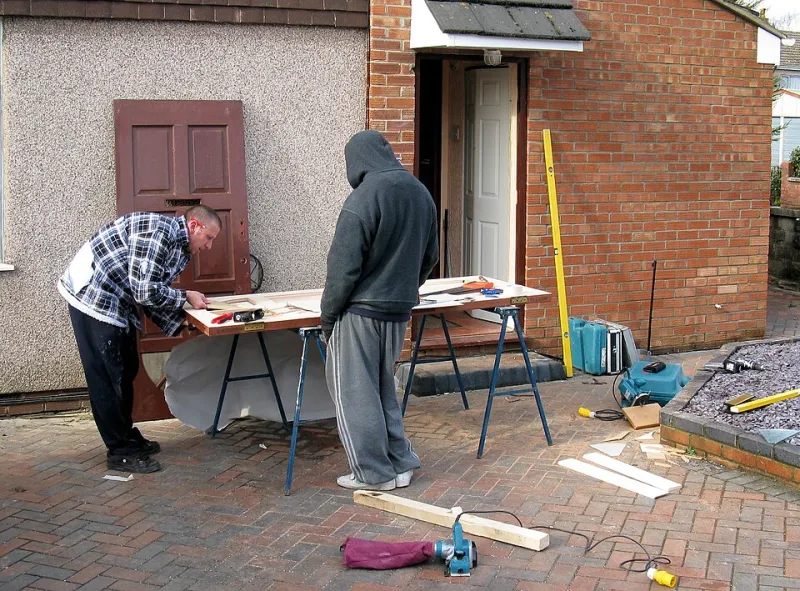
Photo: Adrian Pingstone (Arpingstone), Public domain, via Wikimedia Commons
The van pulls up on a 1960s council estate just outside Leeds at half eight on a Monday morning. The job sheet says 'internal door — sticking'. By lunchtime the carpenter has planed the door, adjusted the hinges, replaced a strike plate worn loose by twenty years of use, and written the same note he has written a hundred times before: frame movement, likely original install, recommend full survey.
Nobody will survey it. He knows that. He will be back in eighteen months.
The Framework Trap
Talk to carpenters and small building firms working on local authority and housing association repair frameworks, and a pattern emerges with remarkable consistency. The work is regular. The work is paid — eventually, and usually on time thanks to prompt payment clauses that social landlords tend to honour. And the work is, almost without exception, the same work, over and over, at rates that have barely moved in half a decade.
'I did three years on a decent refurbishment programme,' one contractor in the West Midlands told us. 'Kitchen replacements, full bathroom refits, rewires alongside. Proper work, priced properly. Then the framework ended, the money dried up, and now I'm on the responsive repairs contract doing the same three jobs on the same streets.'
That shift — from planned investment to perpetual patching — is the quiet story of Britain's social housing maintenance crisis. Decent Homes funding has been squeezed across successive spending rounds. Capital programmes have been raided to cover fire safety remediation, cladding costs and the endless compliance burden of building safety legislation. What is left for routine stock improvement is thin, and what trickles down to the trade is a diet of emergency call-outs and temporary fixes.
Skilled Hands, Diminishing Returns
There is an irony here that the trade feels keenly. The repairs being demanded are not unskilled work. Boarding a stair, splicing a rotten joist end in a confined loft, matching a 1930s sash window profile with modern materials — this is joinery of a high order, often done at speed, in occupied homes, in all weathers.
Yet the pay reflects none of it. Framework day rates for responsive repairs carpenters commonly sit between £180 and £230 for a sole trader carrying all the overheads — van, insurance, CSCS, tools, the works. Compare that with what the same chippy can command on a private extension or a loft conversion, and the arithmetic gets uncomfortable. Several contractors we spoke to described the repairs work as 'the safety net that stops you falling, and stops you climbing'.
The frustration is not really about money, though. It is about futility. A door that needs re-hanging every year because the frame was never properly repaired is not a job; it is a subscription. And the contractor is the one holding the subscription model together with screws and filler.
Is It a Lifeline or a Dead End?
There is a genuine case for the work, and it should be stated fairly. For small firms, repairs frameworks offer something the private domestic market rarely does: pipeline. A three-year contract with guaranteed volumes lets a firm plan, hire an apprentice, invest in a decent van. In a construction economy prone to sudden stops, that certainty is worth real money. One Greater Manchester firm credits a repairs contract with keeping them trading through the 2023–24 slump in private extensions.
But the same contract can become a trap. Firms that spend years on responsive repairs find their estimating muscles atrophy, their public-facing portfolio fills with door adjustments rather than the kind of work that wins private commissions, and their margins get locked in by schedule-of-rates documents that are renegotiated downward, never upward.
The deeper problem belongs to the landlords, not the contractors. Every carpenter we spoke to could name streets where the same stock — same roofs, same frames, same rotten thresholds — generates a rolling income of repair tickets that, added up over a decade, would have funded the refurbishment twice over. Patch-and-return is not cheap. It is merely cheap to budget for.
What Would Change It
The trade does not expect miracles. But the asks are modest and consistent: longer planned maintenance cycles so firms can invest in training; schedules of rates that distinguish between a fifteen-minute adjustment and a half-day structural repair; and, above all, a shift back towards stock condition surveys that treat a recurring repair ticket as evidence, not workload.
Until then, Britain's site carpenters will keep doing what they do best — making things work, one visit at a time, on houses that deserved better a decade ago. The trade will take the work. It always does. But nobody should mistake a diary full of temporary fixes for a healthy maintenance economy. A patch, repeated often enough, is just a decision nobody made.