Half a Loft and No Cheque: A Yorkshire Firm's Six-Month Lesson in Standing Still
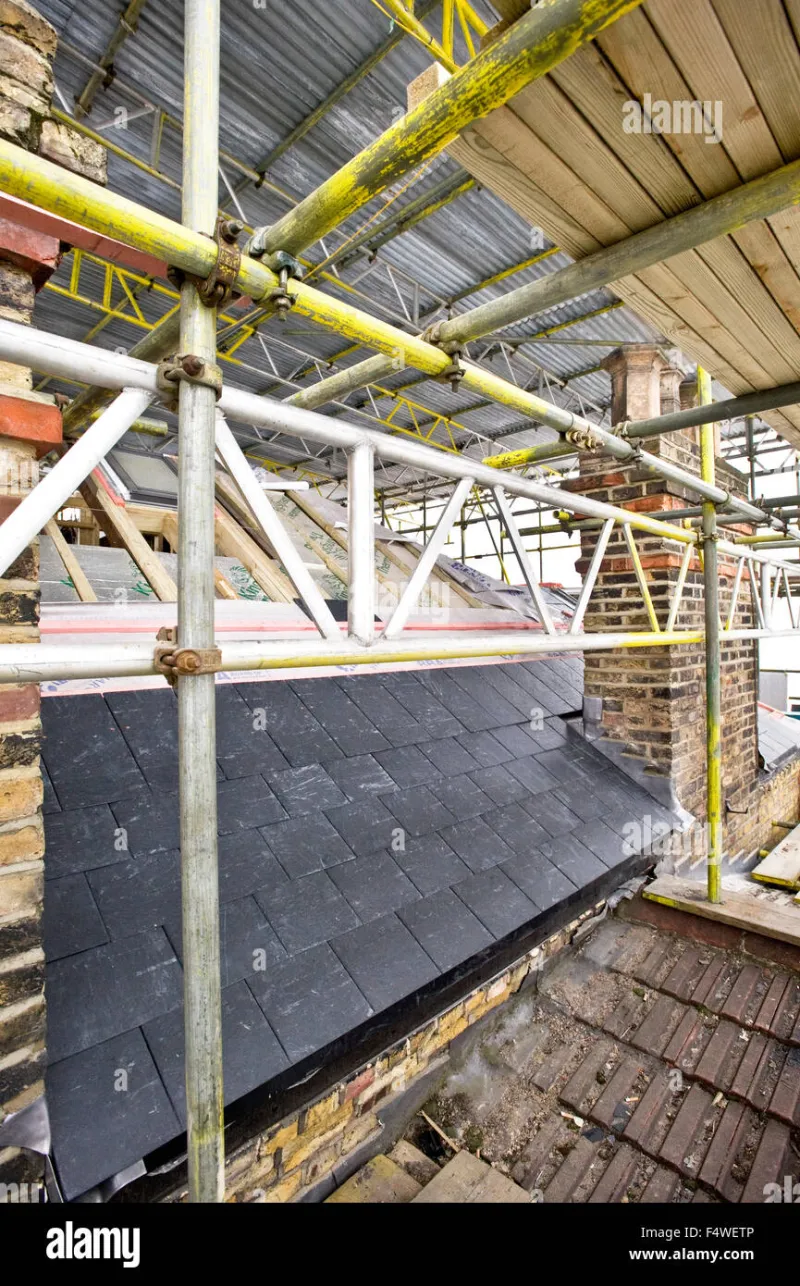
Photo: unfinished loft conversion scaffolding UK house roof, via c8.alamy.com
The scaffolding went up on a Tuesday in early March. By the end of that week, the roof tiles were stacked on the drive of a 1930s semi in Ossett, and a three-man firm from Dewsbury was ready to begin what its owner describes as "a textbook job — loft conversion, twelve weeks, happy client, done."
It became a textbook job in every sense except the one that mattered. Six months later, the firm walked away having absorbed a five-figure loss, and the loft remained half-finished under a temporary covering.
A Payment Schedule Built on Trust
The contract was straightforward by residential standards: an interim payment at commencement, a second on completion of the structural work, and a final payment at practical completion. The first payment landed on time. The second did not.
"We'd put the steels in, the floor joists were down, the dormer was weathered," the builder told us, asking not to be named because the matter was referred to solicitors. "Then the calls stopped getting answered. Not hostile — just gone. You learn quickly that silence is worse than an argument."
With no payment and no instruction, the crew stood down. What followed was a crash course in the mechanics of construction law that many small firms only receive the hard way.
The Suspension Clause Nobody Read Twice
Under the Housing Grants, Construction and Regeneration Act 1996 — the same legislation that underpins adjudication for larger contracts — a party who is not paid is entitled to suspend performance after giving seven days' written notice. The firm's contract, adapted from a template downloaded years earlier, contained a suspension clause. It had never been tested.
"Suspension is a right, but it's also a decision with consequences," explains a construction solicitor based in Leeds who advises contractors across the North. "You must give proper notice, you must be genuinely entitled to withhold performance, and you should document the state of the works before you leave site — photographs, a written record of materials on site, weatherproofing measures taken. The contractor who suspends cleanly is in a strong position. The one who just downs tools and disappears hands the client a counterclaim."
The Dewsbury firm did, on advice, serve notice and suspend. But the contract's absence of a provision entitling them to cover the costs of the suspension period — something the 1996 Act permits parties to agree — meant those three idle months of van lease, insurance and dormant scaffolding hire came out of their own pocket.
Materials on Site: Whose Are They?
A quieter dispute concerned the materials. Roughly £4,000 of timber, insulation and a rooflight purchased by the firm sat in the half-built loft. Could they remove it?
The answer depends on retention of title. "If you've been paid for the materials, they generally belong to the client," the solicitor notes. "If you haven't, your position is stronger — but ROM clauses in supply terms are only as good as their drafting, and removing goods from a client's property without care can create its own liabilities. Often the pragmatic answer is negotiation, not a van at dawn."
In the end, the firm recovered some materials by agreement during settlement talks; others stayed, effectively abandoned.
The Human Ledger
The financial toll is easy to quantify: lost labour, standing costs, the work written off. The human toll is harder. The firm's lead joiner, a self-employed subcontractor of twenty years, lost six weeks of planned earnings and took a fit-out job with a shopfitter to bridge the gap. The firm's owner spent entire days on the phone to solicitors rather than quoting new work — the true cost of a stalled project, he says, is "the jobs you didn't price because you were chasing the one you had."
There is also the reputational anxiety unique to residential work. "A half-finished loft in someone's house is the worst advert you can have," he says. "Neighbours see scaffolding up for months. You can't put a sign up saying 'not our fault.'"
What the Trade Should Take From Ossett
The lessons are unglamorous but worth restating:
- Stage payments tightly. Tie interim payments to clearly defined, inspectable milestones rather than calendar dates, and never let the gap between payments exceed the value of work you can afford to fund.
- Draft for suspension. Ensure your contract entitles you to recover the reasonable costs of suspending and re-mobilising — a right the law allows you to contract for.
- Record everything. Photographic evidence of the works at suspension, a signed site record and dated correspondence turned out to be the firm's strongest assets in settlement.
- Check the client, not just the job. A simple pre-contract conversation about how the client is funding the build — savings, remortgage, a further advance — would have flagged risk before the first steel went in.
- Consider adjudication early. Statutory adjudication applies to most residential contracts where the occupier has agreed in writing, and a decision can be obtained in weeks, not years.
An Ending, Of Sorts
In September, a settlement was reached: a partial payment, a release of claims, and an agreement that the client would appoint another contractor to complete. The Dewsbury firm moved on to a barn conversion near Horbury — a job that, so far, has run precisely to its payment schedule.
The half-finished loft, we're told, has since been completed by someone else. The scaffolding came down in November. For the firm, the six months of standing still were the most expensive education of their working lives — one they'd rather the rest of the trade received second-hand.