Bricks by Byte: A Midlands Firm Puts a £50,000 Robot on the Tools
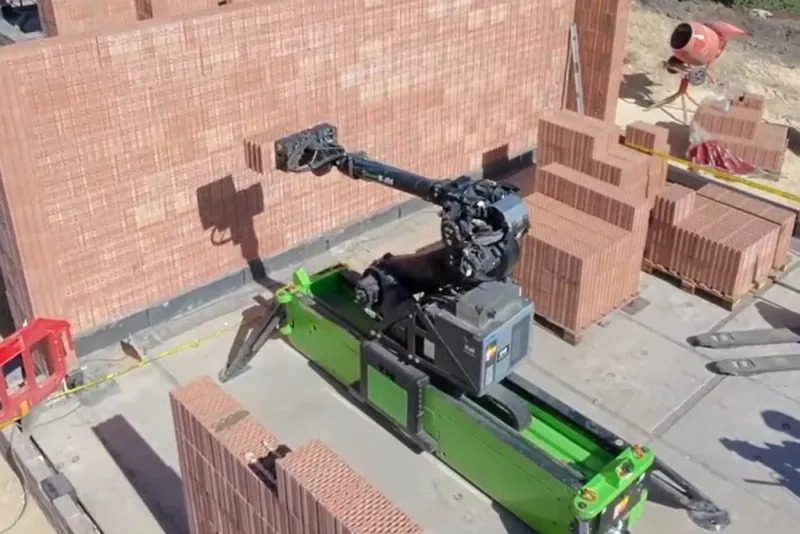
Photo: robotic bricklaying machine on construction site UK, via www.theconstructionindex.co.uk
The morning briefing at the Croft Gardens development in Leicester looks much like any other. Tea, weather complaints, a quick word about the skip being collected. Then site foreman Dave Kaur walks the crew over to a tarpaulin in the corner of the plot and pulls it back to reveal the newest member of the team: a semi-autonomous bricklaying rig, on loan for twelve weeks from a Danish manufacturer keen to prove its kit works on British soil.
For Henshaw & Dean, the six-strong contractor running the job, it is an unusual position to be in. The firm has never employed more than a dozen people, works mostly on small residential developments and extensions, and had never so much as used a laser total station until three years ago. Now it is trialling a machine that carries a list price north of £50,000 — roughly the annual wage bill for two labourers.
"We didn't say yes because we're futurists," says co-owner Mark Dean. "We said yes because we couldn't get a bricklayer to quote us for love nor money."
The Job at Hand
Croft Gardens is a fourteen-unit mews scheme on a former bus depot, conventional block-and-beam ground floors and a mix of facing brick specified by the developer. It is, in other words, exactly the kind of repetitive masonry work that robotic rigs are built for: long, straight runs, few corners, minimal bespoke detail.
The machine itself is best described as a gantry on tracks. It is set up at the start of a wall run by a trained operator — in this case a manufacturer technician for the first fortnight, then Henshaw & Dean's own labourer, Connor, who was seconded to the trial. From there it picks, applies mortar and lays to a set course height, with a human following behind to point up, check perpends and place wall ties and insulation as required.
It does not lay the whole house. It lays the long runs, and only when the weather, the supply chain and the machine's own software all cooperate.
What the Numbers Actually Said
By week six, the firm had started keeping a chalkboard tally in the site office: courses laid by the rig versus courses laid by the one bricklayer they'd managed to subcontract for the same plots. The results were more nuanced than either the manufacturer's brochure or the sceptics predicted.
On a clean, uninterrupted day, the rig laid roughly 350 to 400 blocks — solid, consistent work with mortar joints you could set a watch by. A good bricklayer on the same runs might manage 500 to 600. But the rig worked through drizzle that would have sent a gang home, never took a Friday off, and produced almost nothing for the snagging pile at the end of the day.
"It's not faster, it's different," says Kaur. "You lose the weather days and you gain the set-up time. Set-up's brutal. Two hours every time you move it. But that wall's plumb to the millimetre, and I've not had one block back for pointing."
The hidden cost, Dean notes, sits in the support contract. Servicing, software subscriptions and a spare-parts arrangement added roughly £9,000 a year on top of the headline price — the kind of figure that never appears in the sales pitch.
The Human Question
The most pointed conversations on site were not about productivity. They were about what the machine means for the labourer learning to run it.
Connor, 24, had been with the firm two years, mostly on the shovel and the mixer. Over the trial he became the operator, learning fault codes, calibration and the peculiar diplomacy of explaining the machine to visiting bricklayers. By the end he was, in the firm's words, "the most expensive-trained labourer in Leicestershire" — and, arguably, a new kind of site technician that the trade hasn't yet got a name for.
Not everyone was reassured. The subcontract bricklayer, who asked not to be named, was blunt: "That thing's doing the runs, I'm doing the details. Today. But someone worked out you'd need four of them and one of me. Do that maths."
Who Can Afford to Automate?
This is where the trial's broader lesson emerges. The rig worked at Croft Gardens because the job was big enough, repetitive enough and long enough to amortise the set-up times. The same machine on a single domestic extension would be an expensive ornament.
That reality risks widening an existing divide. The national housebuilders and tier-one contractors — the ones already running BIM models and digital site diaries — are the natural customers. The small firms who make up the bulk of the trade, and who are losing their bricklayers to retirement faster than they can replace them, cannot justify the outlay on the work they actually win.
"Automation won't fix the shortage," Dean reflects. "It'll fix the shortage for whoever can afford it. Everyone else will be competing for the same shrinking pool of hands — and maybe paying more for them."
Henshaw & Dean will not be buying a rig when the trial ends. But Dean admits the firm has asked about leasing arrangements, and about whether a smaller, cheaper version is on the roadmap. The chalkboard tally has been photographed and filed. Whatever happens next, someone at the builders' merchant will be asking about it soon.